
READ — ABOUT 6 MINUTES
There are ages at which the world seems to expect a woman to be becoming something.
At twenty-five, she may be building.
At thirty-five, achieving.
At forty-five, managing.
And somewhere beyond that, the language can begin to change.
People ask when she will slow down.
They speak of retirement.
They talk about making room for the next generation.
Some of those changes are good and necessary. Life has seasons, and wisdom knows when a season has changed.
But there is a difference between a role ending and usefulness ending.
There is a difference between doing less and having less to give.
And there is certainly a difference between growing older and becoming irrelevant.
When the Assignment Changes
Perhaps one of the challenges of the second half of life is that purpose may no longer arrive wearing the clothes we recognize.
For years, purpose may have looked like raising children, earning a living, building a career, caring for parents, leading a ministry, running a household, teaching, creating, serving, or solving the problem directly in front of us.
Then something changes.
The children grow.
The position ends.
The organization continues without us.
The body requires different accommodations.
A relationship changes.
A door that once stood open closes.
If we have attached purpose too tightly to a particular role, the end of that role can feel strangely like the end of ourselves.
But Scripture offers another possibility.
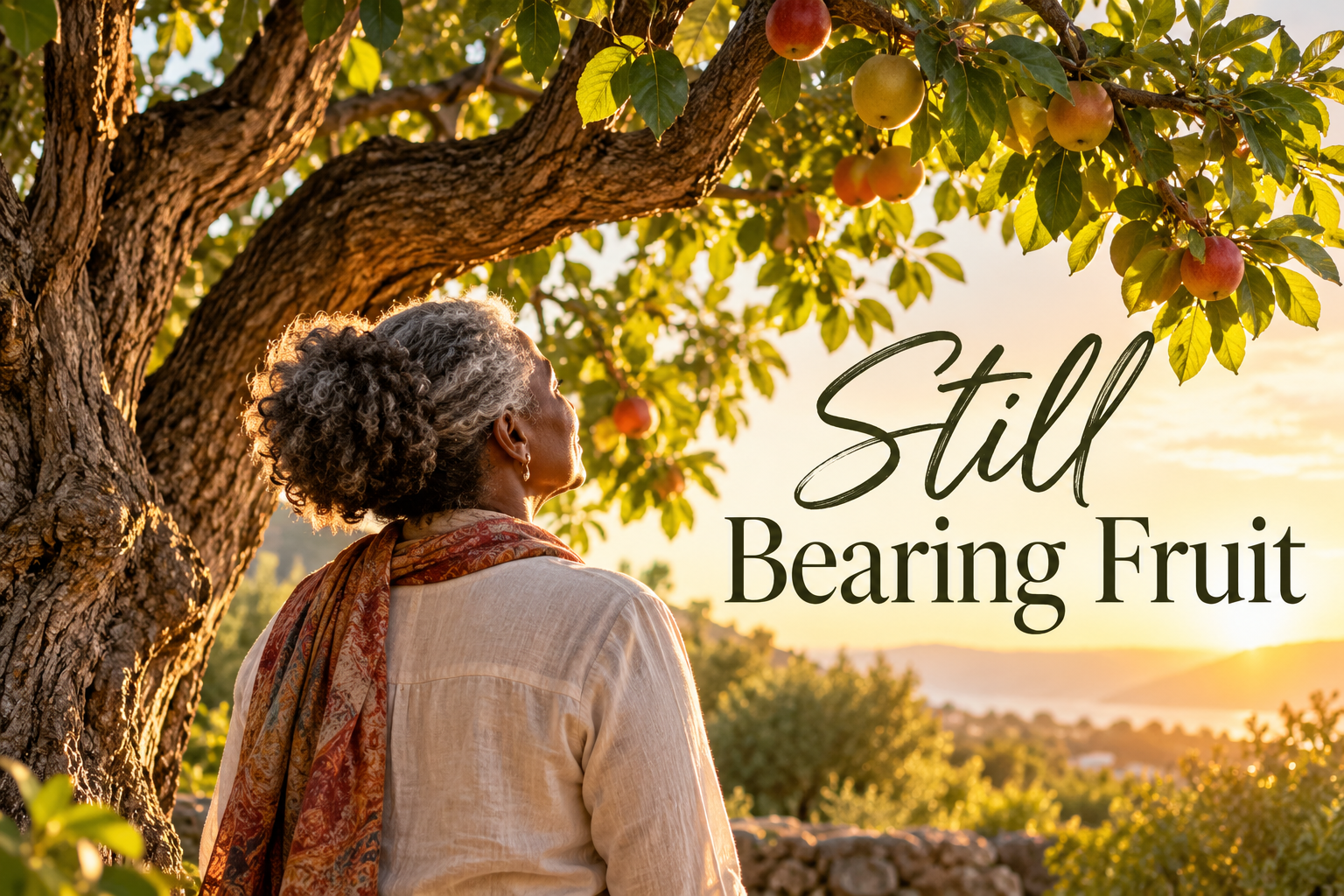
Psalm 92:12–15 describes the righteous as flourishing and says that even in old age, “they will still bear fruit.”
Still.
That small word matters.
In this sentence, still carries the idea of continuation. Something has not stopped simply because time has passed. There was fruit before, and there can be fruit yet. What God has cultivated through the years does not automatically become unusable because we have entered another season.
The passage does not promise that the fruit will always look the same.
It says there can still be fruit.
Fruit May Change
There are things I could do at thirty that I may not choose—or be able—to do now.
But age has given me things thirty could not.
Perspective.
Pattern recognition.
Stories with endings I had not yet lived long enough to see.
A greater awareness of what deserves my energy and what does not.
Experience does not automatically make us wise. Years alone cannot accomplish that.
But years that have been examined can become something useful.
A woman who has learned from what she has lived carries something different from a woman who is simply trying to repeat her younger self.
Perhaps the question is no longer:
Can I still do what I used to do?
Perhaps it is:
What can grow from what I know now?
Sometimes the Fruit Is New
Anna Mary Robertson Moses spent much of her life working, raising a family, farming, sewing, and making things with her hands.
The world would eventually know her as Grandma Moses.
She did not begin painting in earnest until her late seventies. At 80, she had her first solo exhibition. Her scenes of rural American life eventually made her one of the country’s best-known self-taught artists. By the time she died at 101, she had created more than 1,500 paintings.
Her story is worth noticing not because every woman needs a dramatic second act.
We do not.
It is worth noticing because the later years of her life contained something that could not have been predicted simply by looking at the roles she had already completed.
The fruit was not merely more of what had come before.
Some of it was new.
Perhaps that is another way to think about still.
Still learning.
Still creating.
Still contributing.
Still discovering what has been growing quietly beneath the surface.
A later season does not have to imitate an earlier one to be fruitful.
Purpose and the Years Ahead
Researchers have also been examining purpose in later life.
A large study published in 2025 followed older adults over time across two major aging studies. Those with a stronger sense of purpose had a lower risk of moving from normal cognition to mild cognitive impairment, were more likely to experience cognitive improvement, and had longer cognitively healthy life expectancies.
Another 2025 study followed a diverse national sample of 9,808 adults age 65 and older. Researchers found that people whose sense of purpose declined less over time also tended to experience less cognitive decline.
These studies do not tell us that finding a purpose will prevent cognitive decline.
They tell us something more modest and still worth noticing: maintaining a sense of purpose is associated with healthier cognitive aging.
Scripture is making a different kind of claim.
It reminds us that later life need not be spiritually barren.
The Map
Sometimes we continue measuring fruitfulness with an old measuring stick.
Perhaps the map says:
I am no longer needed in the way I once was.
I miss the woman I was in that season.
I thought I would have accomplished more by now.
I have experience, but I am not sure where it belongs.
I have spent so many years caring for other people that I am unsure what God is asking of me now.
Those observations do not have to be corrected immediately.
They can simply be seen.
The map shows what is.
And sometimes what is includes grief for a role, identity, capacity, or season that has genuinely ended.
We do not have to call that grief ingratitude.
But neither must we mistake an ending for evidence that nothing remains.
The Lantern
This week, instead of asking yourself to discover some enormous new purpose, try something smaller.
Ask:
What do I carry now that could be useful to someone else?
It might be knowledge.
Patience.
Discernment.
Encouragement.
A skill.
A story.
Hospitality.
The willingness to listen without immediately fixing.
The courage to tell a younger woman something you wish someone had told you.
Then choose one small way to put that fruit within someone’s reach.
Not to prove that you are still valuable.
Not to remain indispensable.
Simply because something has grown in you, and perhaps it was never intended to stop with you.
60 Seconds
For one minute, become quiet.
Think about the woman you were twenty or thirty years ago.
Notice something she did not yet know.
Something life taught you.
Something God taught you.
Something you learned through joy, error, waiting, loss, obedience, beginning again—or simply living long enough to see more clearly.
Do not decide yet what you should do with it.
For sixty seconds, simply recognize that it is there.
You have lived.
You have learned.
And there may still be fruit growing from those years.
Reflection
What has grown in you that this season of your life may be asking you to give?
The map shows me what is. The lantern guides what I choose next.
Sources
Nathan A. Lewis, Scott M. Hofer, David A. Bennett, and Patrick L. Hill, “Sense of Purpose in Life and Extending the Cognitive Healthspan: Evidence from Multistate Survival Modeling”, Aging, Neuropsychology, and Cognition 32, no. 2 (2025): 237–251.
Elliot M. Friedman, Patricia A. Thomas, Madison R. Sauerteig-Rolston, Lisa L. Barnes, and Kenneth F. Ferraro, “Sustained Purpose in Life Is Associated With Slower Cognitive Decline in Older Adults: A Longitudinal Analysis With a Diverse National Sample”, The Journals of Gerontology: Series B 80, no. 6 (2025).
Leave a Reply