
READ — ABOUT 5 MINUTES
There are seasons of life when faithfulness looks impressive from the outside.
A difficult decision is made. A long-awaited door opens. A relationship is restored. Something that has been prayed over for years finally changes.
And then there are the other seasons.
You get up. You make the bed. You answer the message you would rather avoid. You keep the appointment. You prepare the meal. You tell the truth kindly. You resist saying the thing that would feel satisfying for thirty seconds and troublesome for three days.
Nothing about it feels remarkable.
But perhaps we have underestimated the spiritual significance of an ordinary day.
The Quiet Work of Becoming
By the time a woman reaches the middle years of life, she has usually accumulated evidence of who she has been.
There are choices she is proud of and others she would make differently. There are habits that have served her well and some that have simply traveled with her for so long that they have begun to feel like personality.
“I am just that way.”
“I have always done that.”
“That is how I respond.”
Those sentences can describe us accurately. They do not necessarily have to define what comes next.
Scripture gives us a different picture of growth. Paul writes, “Do not conform to the pattern of this world, but be transformed by the renewing of your mind” (Romans 12:2).
Transformation sounds enormous.
Renewal often is not.
Sometimes renewal happens in the few seconds between what happens to us and what we choose to do next.
That is where an ordinary Tuesday afternoon can become sacred ground.
Small Choices Still Count
We tend to notice the large decisions of our lives because their consequences are easy to see.
But much of a life is constructed differently.
It is built through repetition.
Research on habit formation supports what ordinary life often teaches us: repeated small actions matter. In one study, participants practiced a simple behavior in the same context each day. Over time, the behavior became increasingly automatic. The time required varied considerably from person to person, and missing one opportunity did not significantly disrupt the process. Change was built through repetition, not perfection.¹
That matters.
We do not have to perform a new response perfectly for it to begin becoming more familiar. We practice it. Then we practice it again.
A Life Made of Small Things
Scripture gives us a beautiful picture of repeated faithfulness in the life of a woman named Tabitha, also called Dorcas.
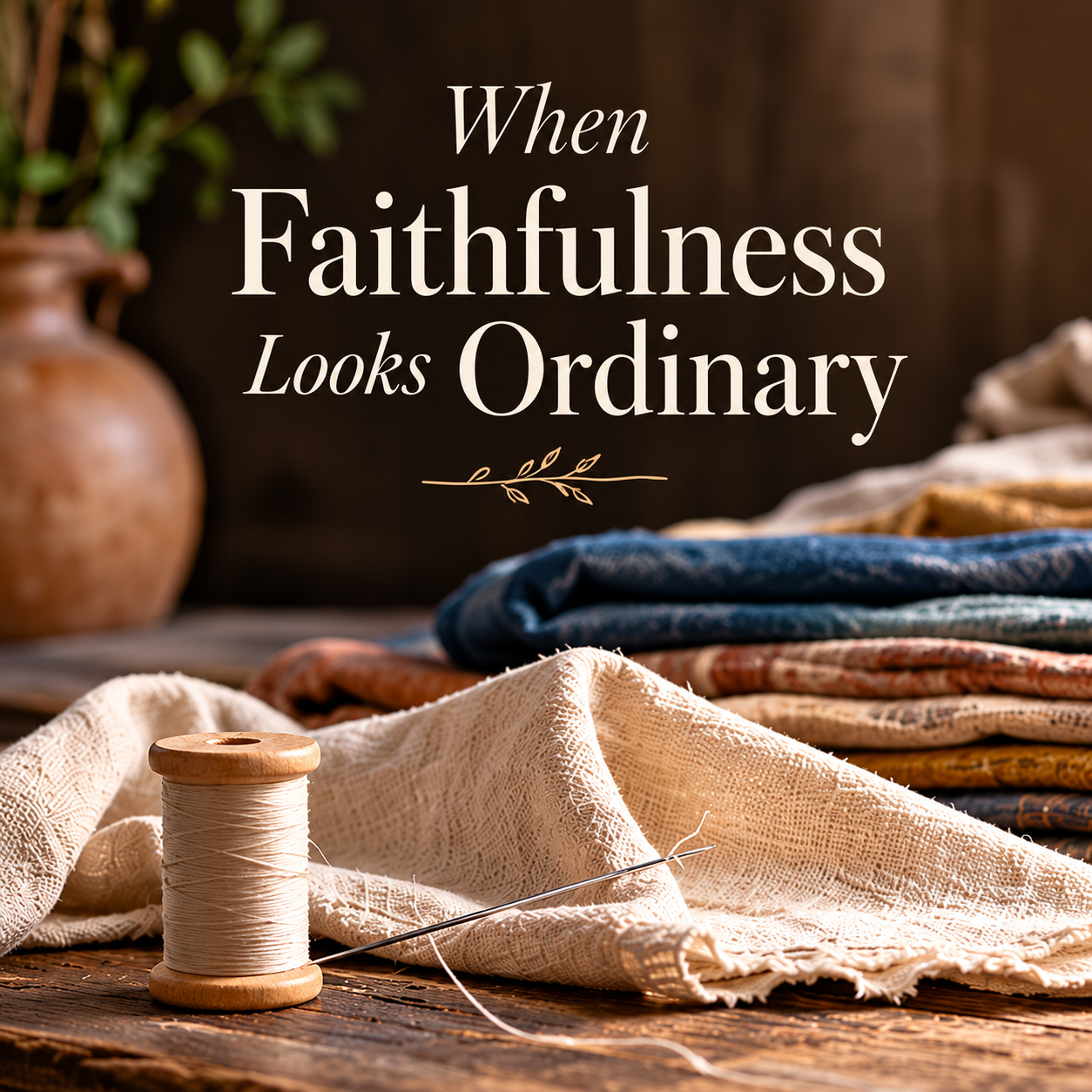
Acts 9 describes her as a disciple who was “always doing good and helping the poor.” When she died, the widows gathered around Peter. They showed him the clothing Dorcas had made while she was with them.
Think about that scene.
The evidence of her faithfulness was hanging in the room.
There was not one garment.
There were garments.
A needle. A garment. A woman helped. Then another.
Scripture does not tell us that Dorcas was trying to establish a habit. It shows us something perhaps even more important: a pattern of faithfulness. She kept doing good. She kept serving. And the accumulation of those seemingly ordinary acts became part of other women’s lives.
Perhaps Dorcas did not know, while doing the work, what all those individual acts would eventually represent. But when the women stood together holding what she had made, the small things were no longer small.
Together, they told the story of a life.
The woman who pauses before responding is practicing something.
The woman who admits, “I was wrong,” is practicing something.
The woman who notices that resentment has returned and refuses to feed it is practicing something.
The woman who keeps a boundary without becoming cruel is practicing something.
The woman who chooses gratitude while still acknowledging what hurts is practicing something.
None of these moments may become a story she tells anyone.
They still matter.
Jesus spoke often about faithfulness in what appears small. In Luke 16:10, He says, “Whoever can be trusted with very little can also be trusted with much.”
We sometimes read “very little” as though it means unimportant.
It does not.
The small thing may simply be the place where faithfulness is being formed.
The Map
There is value in noticing what you repeatedly do without judging yourself for finding it.
Perhaps your map says:
When I feel dismissed, I become sharp.
When I am overwhelmed, I withdraw.
When I am afraid, I try to control the outcome.
When I am tired, I agree to things I do not actually have the capacity to do.
That is information.
The map does not condemn you.
It shows you what is.
And once something can be seen clearly, you have an opportunity to choose.
The Lantern
This week, choose one ordinary response you would like to practice differently.
Not five.
One.
When the familiar moment arrives, pause long enough to ask:
What response would be consistent with the woman I am becoming?
You may still feel irritated.
You may still feel afraid.
You may still want to retreat, defend yourself, explain yourself, or fix everything immediately.
The goal is not to manufacture a different feeling.
The practice is to make a more intentional choice.
Perhaps that choice will be visible only to you and God.
That is enough.
60 Seconds
For one minute, become quiet.
Notice what has been occupying your attention.
Notice what you are carrying in your body.
Notice whether there is a familiar response that has been appearing lately.
Do not solve it.
Do not rehearse the conversation.
Simply sit quietly before God and notice.
Then ask yourself:
What is one small act of faithfulness available to me today?
Reflection
At this stage of your life, what ordinary response are you ready to practice differently?
The map shows me what is. The lantern guides what I choose next.
Sources
¹ Phillippa Lally, Cornelia H. M. van Jaarsveld, Henry W. W. Potts, and Jane Wardle, “How Are Habits Formed: Modelling Habit Formation in the Real World”, European Journal of Social Psychology 40 (2010): 998–1009.
Leave a Reply